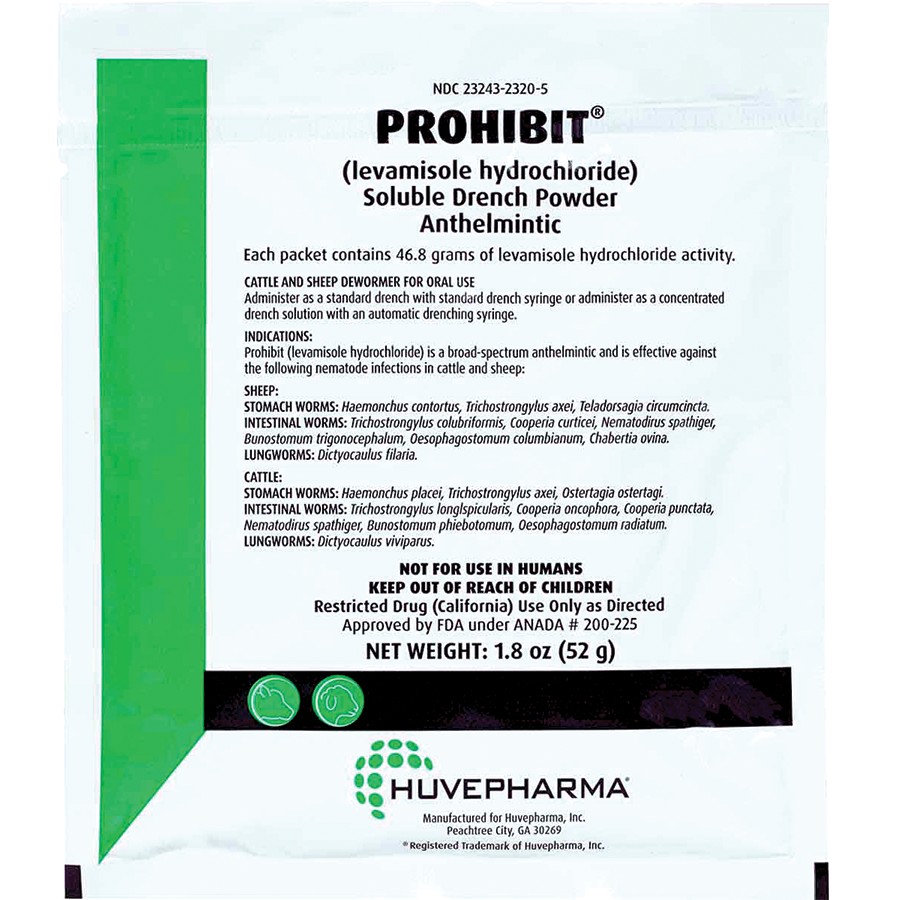
CATTLE AND SHEEP DEWORMER FOR ORAL USE
Administer as a standard drench with standard drench syringe or administer as a concentrated drench solution with an automatic drenching syringe.
INDICATIONS:
Prohibit (levamisole hydrochloride) is a broad-spectrum anthelmintic and is effective against the following nematode infections in cattle and sheep:
SHEEP:
STOMACH WORMS: Haemonchus contortus, Trichostrongylus axei, Teladorsagia circumcincta.
INTESTINAL WORMS: Trichostrongylus colubriformis, Cooperia curticei, Nematodirus spathiger, Bunostomum trigonocephalum, Oesophagostomum columbianum, Chabertia ovina.
LUNGWORMS: Dictyocaulus filaria.
CATTLE:
STOMACH WORMS: Haemonchus placei, Trichostrongylus axei, Ostertagia ostertagi.
INTESTINAL WORMS: Trichostrongylus longispicularis, Cooperia oncophora, Cooperia punctata, Nematodirus spathiger, Bunostomum phlebotomum, Oesophagostomum radiatum.
LUNGWORMS: Dictyocaulus viviparus.
DOSAGE AND ADMINISTRATION
Packet – CATTLE-STANDARD DRENCH SOLUTION: Place the contents of the packet in a 1 quart (32 fl oz) container, fill with water, swirl until dissolved. Administer as a single drench dose according to the following table:
|
Weight
|
Drench Dosage
|
Packet Will Treat
|
|
200 lb.
|
1/2 fl. oz.
|
64 head
|
|
400 lb.
|
1 fl. oz.
|
32 head
|
|
600 lb.
|
1 1/2 fl. oz.
|
21 head
|
|
800 lb.
|
2 fl. oz.
|
16 head
|
CONCENTRATED DRENCH SOLUTION: For use with automatic syringe. Place the contents of the packet in a standard household measuring container and add water to the 8 3/4 fl. oz. level; or use the measuring container available from your supplier and add water to the mark. Swirl until dissolved. Give 2 ml (milliliter) per 100 lb. body weight. Refer to the table above for the number of cattle the packet will treat.
SHEEP-STANDARD DRENCH SOLUTION: Place the contents of the packet in a 1 gallon (128 fl. oz.) container, fill with water; swirl until dissolved. Administer as a single drench dose according to the following table:
|
Weight
|
Drench Dosage
|
Packet Will Treat
|
|
50 lb.
|
1/2 fl. oz.
|
256 head
|
|
100 lb.
|
1 fl. oz.
|
128 head
|
|
150 lb.
|
1 1/2 fl. oz.
|
84 head
|
|
200 lb.
|
2 fl. oz.
|
64 head
|
CONCENTRATED DRENCH SOLUTION: Packet – For use with automatic syringe. Place the contents of the packet in a standard household measuring container and add water to the 17 1/2 fl. oz. level. Swirl until dissolved. Give 2 ml per 50 lb. body weight. Refer to the table above for the number of sheep the packet will treat.
DOSAGE AND ADMINISTRATION: Bottle – When you are ready to deworm your cattle or sheep, add water to the powder in the bottle up to the 3 liter mark. Swirl to mix thoroughly before using. If any solution is left over, it may be stored for up to 3 months in the tightly capped bottle, shake well before using.
DATE WATER WAS ADDED TO THE BOTTLE
Month Day Year
Administer as a single drench dose as follows:
Cattle–2 mL per 100 lb. body weight
|
Weight
|
Drench Dosage
|
Bottle Will Treat
|
|
100 lb.
|
2 mL
|
1,500 head
|
|
300 lb.
|
6 mL
|
500 head
|
|
500 lb.
|
10 mL
|
300 head
|
|
700 lb.
|
14 mL
|
214 head
|
|
1,000 lb.
|
20 mL
|
150 head
|
Sheep–1 mL per 50 lb. body weight
|
Weight
|
Drench Dosage
|
Bottle Will Treat
|
|
50 lb.
|
1 mL
|
3,000 head
|
|
100 lb.
|
2 mL
|
1,500 head
|
|
150 lb.
|
3 mL
|
1,000 head
|
|
200 lb.
|
4 mL
|
750 head
|
Do not underdose. Ensure each animal receives a complete dose based on a current body weight. Underdosing may result in ineffective treatment, and encourage the development of parasite resistance.
NOTE: Careful weight estimates are essential for proper performance of this product. Prepare solutions as needed. However, excess solutions may be stored in clean closed containers up to 90 days without loss of anthelmintic activity. Cattle and Sheep maintained under conditions of constant helminth exposure may require re-treatment within two to four weeks after the first treatment.
|
|
RESIDUE WARNING: Do not administer to cattle within 48 hours of slaughter for food. Do not administer to sheep within 72 hours of slaughter for food. To prevent residues in milk, do not administer to dairy animals of breeding age.
|
|
OTHER WARNINGS: Parasite resistance may develop to any dewormer, and has been reported for most classes of dewormers. Treatment with a dewormer used in conjunction with parasite management practices appropriate to the geographic area and the animal(s) to be treated may slow the development of parasite resistance. Fecal examinations or other diagnostic tests and parasite management history should be used to determine if the product is appropriate for the herd/flock, prior to the use of any dewormer. Following the use of any dewormer, effectiveness of treatment should be monitored (for example, with the use of a fecal egg count reduction test or another appropriate method). A decrease in a drug’s effectiveness over time as calculated by fecal egg count reduction tests may indicate the development of resistance to the dewormer administered. Your parasite management plan should be adjusted accordingly based on regular monitoring.
CAUTION: Muzzle foam may be observed. However, this reaction will disappear within a few hours. If this condition persists, a veterinarian should be consulted. Follow recommended dosage carefully. Consult veterinarian before using in severely debilitated animals.
Consult your veterinarian for assistance in the diagnosis, treatment, and control of parasitism.

Reviews
There are no reviews yet.