INDICATIONS
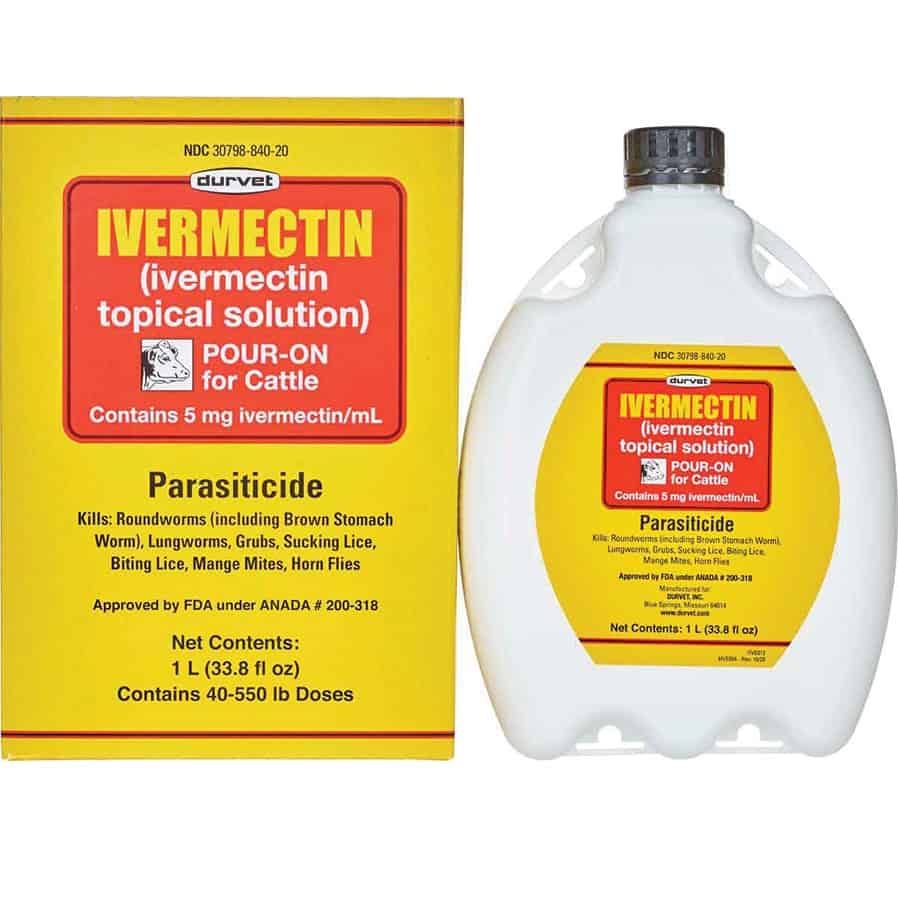
IVERMECTIN (ivermectin topical solution) Pour-On applied at the recommended dose level of 500 mcg/kg is indicated for the effective control of these parasites.
Gastrointestinal Roundworms
Ostertagia ostertagi (including inhibited stage) (adults and L4)
Haemonchus placei (adults and L4)
Trichostrongylus axei (adults and L4)
T. colubriformis (adults and L4)
Cooperia oncophora (adults and L4)
Cooperia punctata (adults and L4)
Cooperia surnabada (adults and L4)
Strongyloides papillosus (adults)
Oesophagostomum radiatum (adults and L4)
Trichuris spp. (adults)
Lungworms
Dictyocaulus viviparus (adults and L4)
Cattle Grubs
(parasitic stages)
Hypoderma bovis
H. Iineatum
Mites
Sarcoptes scabiei var. bovis
Lice
Linognathus vituli
Haematopinus eurysternus
Damalinia bovis
Solenopotes capillatus
Horn Flies
Haematobia irritans
PERSISTENT ACTIVITY
Ivermectin topical solution has been proved to effectively control infections and to protect cattle from re-infection with: Oesophagostomum radiatum and Dictyocaulus viviparus for 28 days after treatment; Cooperia punctata and Trichostrongylus axei for 21 days after treatment; Ostertagia ostertagi, Haemonchus placei, Cooperia oncophora and Cooperia surnabada for 14 days after treatment; Damalinia bovis for 56 days after treatment.
TREATMENT OF CATTLE FOR HORN FLIES
IVERMECTIN (ivermectin topical solution) Pour-On controls horn flies (Haematobia irritans) for up to 28 days after dosing. For best results IVERMECTIN (ivermectin topical solution) Pour-On should be part of a parasite control program for both internal and external parasites based on the epidemiology of these parasites. Consult your veterinarian or an entomologist for the most effective timing of applications.
DOSAGE
The dose rate is 1 mL for each 22 lb of body weight. The formulation should be applied along the topline in a narrow strip extending from the withers to the tailhead.
Do not underdose. Ensure each animal receives a complete dose based on a current body weight. Underdosing may result in ineffective treatment, and encourage the development of parasite resistance.
ADMINISTRATION
Measure-Squeeze-Pour System (33.8 fl oz/1 Liter Bottle with 25 mL Measuring Cap)
This pack contains 1 measuring cap and 1 dip tube.
1. Insert the dip tube into the base of the measuring cap. Leave the “slotted end” of the dip tube exposed in the bottom of the container.
2. Unscrew shipping cap from container top.
3. Screw measuring cap onto container top.
4. Measure: To select the correct dose rate, rotate the adjuster cap (top) in either direction to position the dose indicator to the weight of the animal you want to treat. When body weight is between markings, use the higher setting.
5. Squeeze the container gently to fill the measuring cap to the required dose. Release your grip and any excess will return to the container.
6. Pour: Apply the full dose by tipping and pouring along the backline of the animal until the measuring cap is empty.
7. Storage: The measuring cap should not remain attached to the container when not in use. Detach the measuring cap after each use and replace the shipping cap to close the container top.
BackPack (84.5 fl oz/2.5 Liter Pack and 169 fl oz/5 Liter Pack)
Connect the applicator gun to the backpack as follows:
• Attach the open end of the draw-off tubing to the dosing equipment. (Because of the solvents used in the formulation, only the Protector Drench Gun from Instrument Supplies Limited, or equivalent, is recommended. Other applicators may exhibit compatibility problems resulting in locking, incorrect dosage or leakage).
• Replace the shipping cap with the draw-off cap and tighten down.
• Attach draw-off tubing to the draw-off cap.
• Gently prime the applicator gun, checking for leaks.
• Follow the manufacturer’s directions for adjusting the dose.
• When the interval between uses of the applicator gun is expected to exceed 12 hours, disconnect the gun and draw-off tubing from the product container and empty the product from the gun and tubing back into the product container. To prevent removal of special lubricants from the Protector Drench Gun, the gun and tubing must not be washed.
ANIMAL SAFETY
Studies conducted in the U.S.A. have demonstrated the safety margin for ivermectin. Based on plasma levels, the topically applied formulation is expected to be at least as well tolerated by breeding animals as is the subcutaneous formulation which had no effect on breeding performance.
WARNING
NOT FOR USE IN HUMANS.
Keep this and all drugs out of the reach of children.
The Safety Data Sheet (SDS) contains more detailed occupational safety information. To report suspected adverse drug events, for technical assistance or to obtain a copy of the SDS, contact Bimeda, Inc. at 1-888-524-6332. For additional information about adverse drug experience reporting for animal drugs, contact FDA at 1-888-FDA-VETS or online at www.fda.gov/reportanimalae.
WARNING! FLAMMABLE!
KEEP AWAY FROM HEAT, SPARKS, OPEN FLAME, AND OTHER SOURCES OF IGNITION.
This product should not be applied to self or others because it may be irritating to human skin and eyes and absorbed through the skin. To minimize accidental skin contact, the user should wear a long-sleeved shirt and rubber gloves. If accidental skin contact occurs, wash immediately with soap and water. If accidental eye exposure occurs, flush eyes immediately with water and seek medical attention.
|
|
RESIDUE WARNING: Cattle must not be treated within 48 days of slaughter for human consumption. Because a withdrawal time in milk has not been established, do not use in female dairy cattle of breeding age. A withdrawal period has not been established for this product in pre-ruminating calves. Do not use in calves to be processed for veal.
|
|
PRECAUTIONS
• Store at 20°C – 25°C (68°F – 77°F) and protect from light. Excursions permitted to 104°F (40°C).
• Use only in well-ventilated areas or outdoors.
• Close container tightly when not in use.
• Cattle should not be treated when hair or hide is wet since reduced efficacy may be experienced.
• Do not use when rain is expected to wet cattle within six hours after treatment.
• This product is for application to skin surface only. Do not give orally or parenterally.
• Cloudiness in the formulation may occur when IVERMECTIN Pour-On is stored at temperatures below 32°F. Allowing to warm at room temperature will restore the normal appearance without affecting efficacy.
• Antiparasitic activity of ivermectin will be impaired if the formulation is applied to areas of the skin with mange scabs or lesions, or with dermatoses or adherent materials, e.g., caked mud or manure.
• Ivermectin has been associated with adverse reactions in sensitive dogs; therefore, IVERMECTIN (ivermectin topical solution) Pour-On is not recommended for use in species other than cattle.
• Restricted Drug (California)-Use only as directed.
When to Treat Cattle with Grubs
IVERMECTIN (ivermectin topical solution) Pour-On effectively controls all stages of cattle grubs. However, proper timing of treatment is important. For the most effective results, cattle should be treated as soon as possible after the end of the heel fly (warble fly) season. While this is not peculiar to ivermectin, destruction of Hypoderma larvae (cattle grubs) at the period when these grubs are in vital areas may cause undesirable host-parasite reactions. Killing Hypoderma lineatum when it is in the esophageal tissues may cause bloat; killing H. bovis when it is in the vertebral canal may cause staggering or paralysis. Cattle should be treated either before or after these stages of grub development.
Cattle treated with IVERMECTIN (ivermectin topical solution) Pour-On at the end of the fly season may be re-treated with IVERMECTIN (ivermectin topical solution) Pour-On during the winter without danger of grub-related reactions. For further information and advice on a planned parasite control program, consult your veterinarian.
OTHER WARNINGS
Parasite resistance may develop to any dewormer, and has been reported for most classes of dewormers.
Treatment with a dewormer used in conjunction with parasite management practices appropriate to the geographic area and the animal(s) to be treated may slow the development of parasite resistance.
Fecal examinations or other diagnostic tests and parasite management history should be used to determine if the product is appropriate for the herd/flock, prior to the use of any dewormer.
Following the use of any dewormer, effectiveness of treatment should be monitored (for example, with the use of a fecal egg count reduction test or another appropriate method).
A decrease in a drug’s effectiveness over time as calculated by fecal egg count reduction tests may indicate the development of resistance to the dewormer administered. Your parasite management plan should be adjusted accordingly based on regular monitoring.

Reviews
There are no reviews yet.